
Proposed 2026 Transit Service Changes
The TriMet Board of Directors is now considering updated service change proposals to go into effect Aug. 23, 2026, as we take action to balance our budget.
New, updated service proposals affect 12 bus lines following recent feedback from riders and the public. Other changes are as originally proposed.
All service proposals remain centered on network efficiency, combining lines or reducing where lines run near others, eliminating some bus lines and moving routes. Our goal is maintaining as much service as possible while focusing our service investment where it is needed and used most.
The proposals below are based on our community engagement in January 2026 and fall 2025.
Updated Proposals - March 11, 2026
- 10
- 16
- 19
- 22
- 23
- 34
- 38
- 58
- 63
- 96
- 97
- 156
Proposed Changes to Begin August 23, 2026
MAX Light Rail
MAX Green Line
Run trains only between Clackamas Town Center and Gateway Transit Center. Use bus lines that run between most MAX Green Line stations and Downtown Portland or transfer to MAX Blue or Red Line trains for trips between Gateway Transit Center and Downtown Portland.


Southeast Portland
Fessenden New name
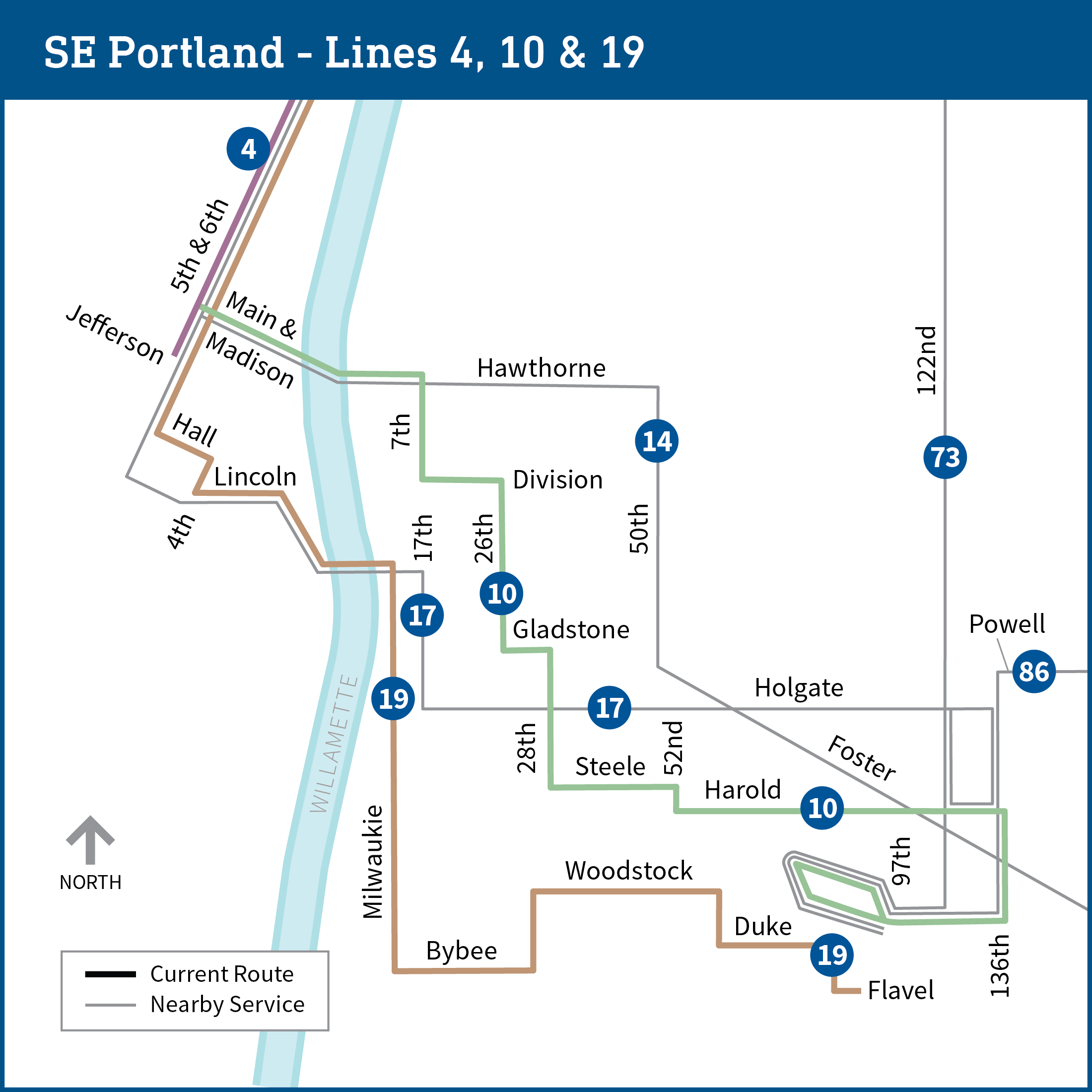
Harold Updated route and new name
Woodstock/Glisan Updated route and new name
Combine Line 19 with Line 4. Adjust the route east of SE 52nd Avenue to serve Woodstock Boulevard and Lents Town Center. Learn more about the Northeast Portland section of Line 19. Between Downtown Portland and Lents Town Center, buses arrive about every 30 minutes most of the day on weekdays and weekends. New route name: 4-Fessenden/Woodstock.
Extend Line 10 on SE 52nd Avenue to serve Line 19 route on SE Duke Street, between 52nd and 72nd avenues, and on SE Flavel Street to serve Mt. Scott and Willamette National Cemetery. Eliminate service on part of SE Harold Street, with other bus lines on SE Foster Road and SE 136th Avenue. Buses arrive between about 7:30 a.m. and 6:30 p.m. on weekdays. No weekend service due to lower ridership. New route name: 10-Steele.

Milwaukie, Happy Valley
Lake/Webster Rd Updated route and new name
Estacada
Milwaukie
Mather Rd Updated route
Maintain Line 156 but shift to SE Summers Lane between Mather Road and SE 122nd Avenue. Combine Line 152 with Line 29. Move Line 29 route to serve SE International Way. Due to low ridership and other nearby bus lines, eliminate service on SE Lake Road between SE 34th Avenue and International Way and on SE Webster Road and SE Johnson Road. New route name: 29-International Way.
Shift Line 30 to serve SE Johnson Road between Highway 212 and Lake Road.
Line 31 continues to run on SE Webster. New route name: 31-Webster/Beavercreek.


Southeast Portland, Milwaukie
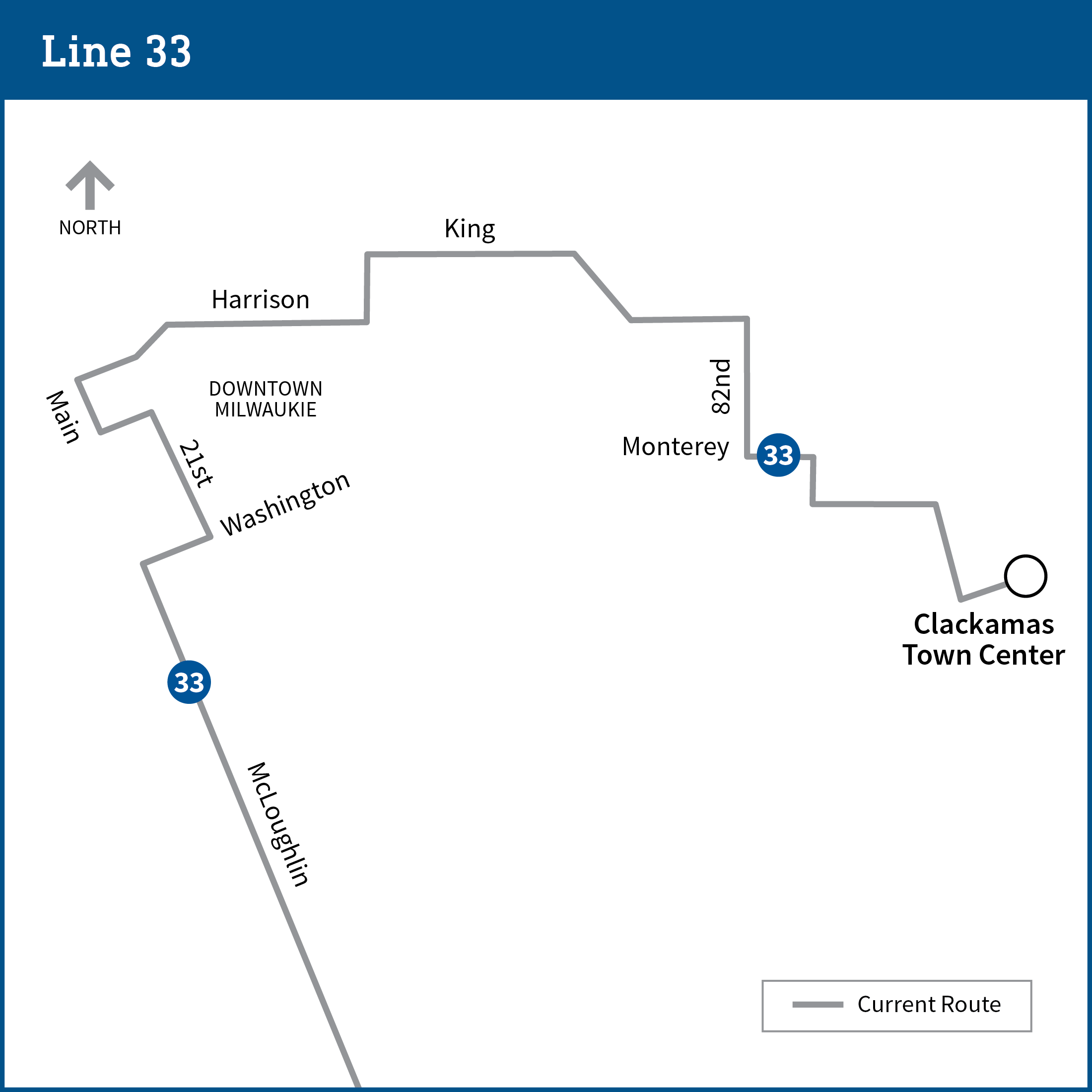
McLoughlin/King Rd
Buses between Milwaukie and Clackamas Town Center would arrive about every 60 minutes after 8 p.m. when fewer people ride in that area.

Linwood/River Rd Updated route and new name
Tacoma/Swan Island
Extend Line 40 to replace Line 34 between the SE Tacoma/Johnson Creek Park & Ride and Clackamas Town Center. Buses arrive about every 60 minutes on weekdays. No weekend service between the Park & Ride and Clackamas Town Center. One morning and one afternoon weekday trip on Line 40 to Fuller Road MAX Station provides a connection between Southeast Portland and MAX Green Line, connecting Cleveland High School students with the Marshall Campus during school construction. Learn more about the Gladstone/Oregon City section of Line 34.


Milwaukie, Gladstone, Oregon City
Webster Rd New name
Oatfield
McLoughlin/King Rd
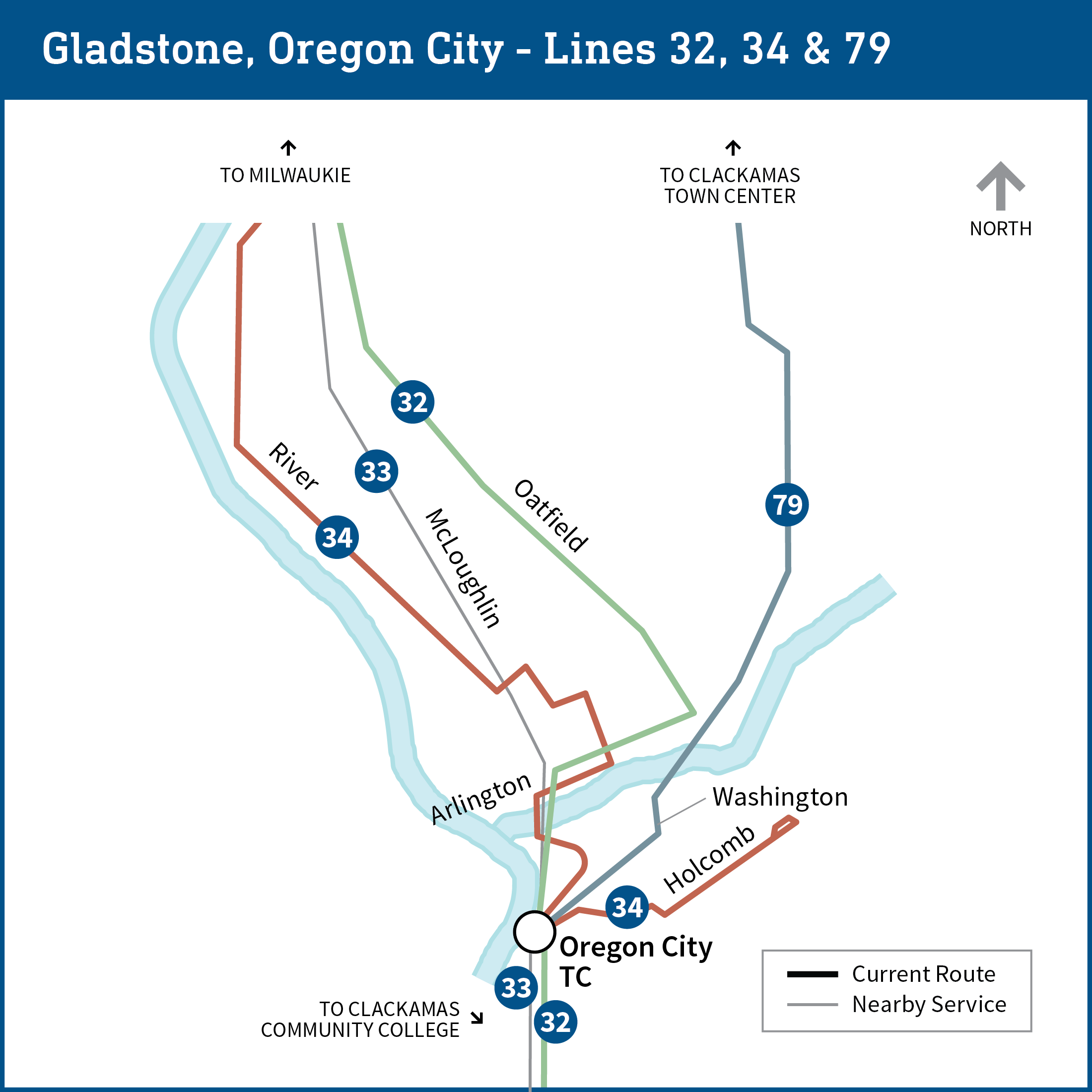
Extend Line 31 to replace Line 32 between Oregon City Transit Center and Clackamas Community College. Move the route to serve SE Linn Avenue and Beavercreek Road. Move Frequent Service Line 33 off Linn to serve 7th Street and Molalla Avenue. Eliminate service on High Street due to low ridership.


Oatfield
Linwood/River Rd Updated route and new name
Clackamas/Oregon City
Combine sections of Line 32, 34 and 79 between Downtown Milwaukie and Clackamas Community College. Learn more about the Southeast Portland/Milwaukie section of Line 34. Move Line 34 to replace Line 32 on SE Oatfield Road between Oak Grove Boulevard and SE 82nd Drive and adjust the route from SE Arlington Street to SE Washington Street. Eliminate service on Oatfield north of Oak Grove Boulevard and on River Road south of Oak Grove Boulevard. Frequent Service Line 33 runs nearby on SE McLoughlin Boulevard and continues to serve Clackamas Community College. Move Line 79 to replace Line 34 on Arlington. New route name: 34-Oatfield/River Rd.

North/Northeast Portland
Jackson Park/NE 15th
Holgate/Broadway New name
12th/NE 33rd Ave New name
Broadway/Halsey
Shorten Line 70 to serve only between Milwaukie and Rose Quarter Transit Center. New route name: 70-Milwaukie Ave/12th.
Move Line 17 to use the Steel Bridge permanently and to replace Line 70 on NE 33rd Avenue/33rd Drive between NE Broadway and NE Sunderland Avenue. Eliminate service on NE 24th, 27th and 29th avenues. Line 17 buses arrive every 30 minutes between Rose Quarter Transit Center and the Columbia River Correctional Institution. New route name: 17-Holgate/NE 33rd.
Adjust Frequent Service Line 8 to run on NE Dekum Street between NE 15th Avenue and the University of Oregon Northeast Portland campus, previously served by Line 17.
Move Line 77 from NE 9th Avenue to NE Grand Avenue/NE MLK Jr. Boulevard to serve more of NE Weidler Street and NE Broadway.


Woodstock/Glisan Updated route and new name
Canyon Rd New name
Maintain Line 19 in Northeast Portland along Glisan Street, serving Providence Portland Medical Center, and combine with Line 58. New route runs between Beaverton and Gateway transit centers. Weekday service will end at about 9:30 p.m. On weekends, buses will arrive about every 60 minutes. New route name: 19-Glisan/Canyon Rd. Learn more about changes to the Southeast Portland section of Line 19.


Parkrose
San Rafael
No changes are being proposed at this time for lines 22 and 23.
Killingsworth/82nd Ave
Buses between Cully Boulevard and Swan Island arrive about every 30 to 40 minutes after 8 p.m. and about every 60 minutes after 10 p.m. when fewer people ride in that area.


North, Northwest Portland
Belmont/NW 23rd
Front Ave/St Helens Rd Updated route and new name
Capitol Hwy/Mocks Crest New name
Shorten Line 16 to run only between NW 44th/Yeon avenues and Downtown Portland. Due to lower ridership and other nearby bus lines, buses serve southbound stops only during morning commute times and northbound stops only during afternoon commute times. No weekend service. New route name: 16-NW Front Ave.
Extend Frequent Service Line 15 to replace Line 16 between Sauvie Island, St. Johns and NW 44th/Yeon avenues only during weekday high school and work commute times.
Shorten Line 44 to serve between PCC Sylvania and Downtown St. Johns. Frequent Service Line 75 continues to serve between Pier Park and N. Richmond Avenue. New route name: 44-Capitol Hwy/N Rosa Parks.


Beaverton, Northwest Portland
Burnside/Stark
Hall/Greenburg
Extend Frequent Service Line 76 to replace Frequent Service Line 20 service between Beaverton Transit Center and Sunset Transit Center. Line 20 continues to run between Sunset and Gresham transit centers. Buses between NW 24th Place and Sunset Transit Center arrive about every 30 to 40 minutes most of the day, as fewer people ride in that area.


Southwest Portland
Arnold Creek/Hillsdale
Garden Home New name
Combine Line 39 and Line 45. New route runs between Washington Square and Barbur Transit Center, serving SW Capitol Highway, Terwilliger Boulevard, SW Boones Ferry Road, SW Stephenson Street and SW 35th Avenue. Other bus lines continue to serve between Hillsdale and Downtown Portland, Barbur Transit Center and Marquam Hill, and Washington Square and Tigard Transit Center. Eliminate weekend service and reduce weekday trips to high school commute hours only. New route name: 45-Garden Home/Arnold Creek.


Vista/Sunset Blvd
Reduce trips to only high school commute times.
Washington Park/SW 6th Updated route and new name
Maintain Line 63 service until August 2027, when service will be reduced to only high school commute times and the route will only run between Lincoln High School and Washington Park. New route name: 63-SW Fairview Blvd.


Lake Oswego, Tigard, Tualatin, Sherwood, West Linn
Lake Grove
Boones Ferry Rd Updated route
Tualatin/I-5 Updated route and new name
Tualatin-Sherwood Rd Updated route and new name
Maintain Line 97 and combine with Line 38. New route runs between Sherwood and Barbur Transit Center, serving Tualatin Park & Ride, SW Kruse Way, SW Boones Ferry Rd, and SW Monroe and McNary parkways. New route name: 97-Tualatin-Sherwood/Kruse Way.
Combine Line 37 with Line 96. Move Line 96 off I-5 to serve Line 37 route on SW Boones Ferry Road, with Line 78 maintaining service along Country Club Road. New Line 96 route serves the Barbur Transit Center and PCC Sylvania via Kerr Parkway. Adjust Line 96 to run only during morning and afternoon commute times and serve limited stops between Barbur Transit Center and Downtown Portland. New route name: 96-Boones Ferry Rd


Hall/Greenburg
Stafford/Salamo
Eliminate Line 76 service between Legacy Meridian Park Hospital in Tualatin and Oregon City Transit Center and eliminate Line 153 due to low ridership.


LIFT Paratransit
Eliminating lines 82-South Gresham and 153-Stafford/Salamo, as well as 76-Hall/Greenburg Rd service between Tualatin, West Linn and Oregon City, changes the LIFT boundary. These changes affect fewer than 0.3% of trips on LIFT.
Provide Feedback
The TriMet Board of Directors is now considering these proposed changes. Provide comments through email to boardtestimony@trimet.org or at a Board meeting. Preregister to provide virtual or in-person testimony. Preregistration closes at noon the day prior to a meeting.
- Wednesday, March 18: Board listening session
- Wednesday, March 25: Board public hearing
Timeline for Proposed Service Changes
-
Comment Period
Jan. 5–31 -
Board Listening Session
March 18 -
First Reading/Public Hearing
March 25 -
Second-Reading/Board Vote
April 22 -
Service Cuts
August 23
— Drag to scroll —
Community Engagement
Winter 2026 outreach
In January 2026, we proposed changes to 35 bus lines and the MAX Green Line. Our Service Cut Proposal Feedback Survey, shared online and through 16 virtual and in-person open houses, received 8,138 responses.
What we heard:
- Concerns regarding elimination of Line 19-Woodstock/Glisan, particularly related to access to medical facilities, disability programs and senior housing
- Concerns about changes to the MAX Green Line and associated transfer reliability
- Concerns about peak-only or reduced service on bus lines serving geographically isolated areas, including lines 16, 34, 38, 44, 76, 96 and 97
- Work and school commute impacts
- Accessibility challenges and increased travel times
- General appreciation for the opportunity to provide feedback
We adjusted service proposals affecting 12 bus lines based on what we heard.
Fall 2025 outreach
In fall 2025, 4,806 people responded to our Service Priorities Survey to share thoughts on what our priorities should be as we reduce service to align spending with our operating revenues. We also took comments through 13 virtual and in-person open house.
What we heard:
- Preserve service as much as possible by first reducing where buses and trains run on the same route or close together
- Keep Frequent Service lines that make our service convenient and reliable
- Maintain transit to reach critical destinations like medical care and schools
That feedback, as well as ridership data, level of impact on riders and jobs and cost-savings informed the proposed service cuts and changes released in January 2026.
Service Reductions
August 2027
TriMet must reduce service levels by at least 10% overall to bring them in line with operating revenue. We will be engaging riders and the public in fall 2026 about another round of service cuts and changes necessary in August 2027.
March 2026
We reduced how often buses arrived on four bus lines during morning and evening hours when ridership was lower. Learn more about March 2026 service changes.
November 2025
We reduced how often buses arrived on five bus lines during night hours when ridership was lower. Learn more about November 2025 service changes
Why Cuts, Why Now
Inflation has led to staggering increases in almost all the costs related to running our transit system. Costs jumped about 56% from 2019 through 2025, with prices skyrocketing for everything from tires to fuel to contracted services.
On the other side, our revenue is falling behind cost increases. The rise in remote work after the pandemic is keeping riders from returning, meaning less money coming in from fares. The office vacancy rate across the region and in Downtown Portland, the hub of our transit system, is at an historic high and foot traffic in the central city during weekdays remains well below 2019 levels. That reduced worker presence directly affects our transit ridership and fare revenue.
Adding to that is dropping payroll tax revenue growth due to the current economic climate in the Portland metro area and the state of Oregon. The state’s unemployment rate is the third highest in the nation. Other state and federal funding is also coming in under what we have forecasted.
TriMet had worked with the Oregon Legislature to include an increase in transit funding as part of an expected comprehensive transportation funding package during the 2025 regular session. While a temporary, two-year increase of 0.1% in the employee payroll tax that funds transit was included in the package passed during a special session in September 2025, it is now going to a public vote with the timing uncertain.
TriMet focused our efforts to increase ridership following the pandemic. We made historic investments in public safety and cleaning. We also invested in changes to our bus network to respond to where people are living and working following the pandemic. Ridership increased year-over-year but the growth is slowing and remains lower than 2019 levels.
Now we must reduce spending to avoid more severe cuts down the road and keep our riders, our region and our economy moving.